The effect of educational video watching speed on cognitive performance: A comparative study
DOI:
https://doi.org/10.23921/amp.2026v9i1.00081Keywords:
Cognitive performance, Hemoglobin, Processing speed, Red blood cells, Sex differences, Task speedAbstract
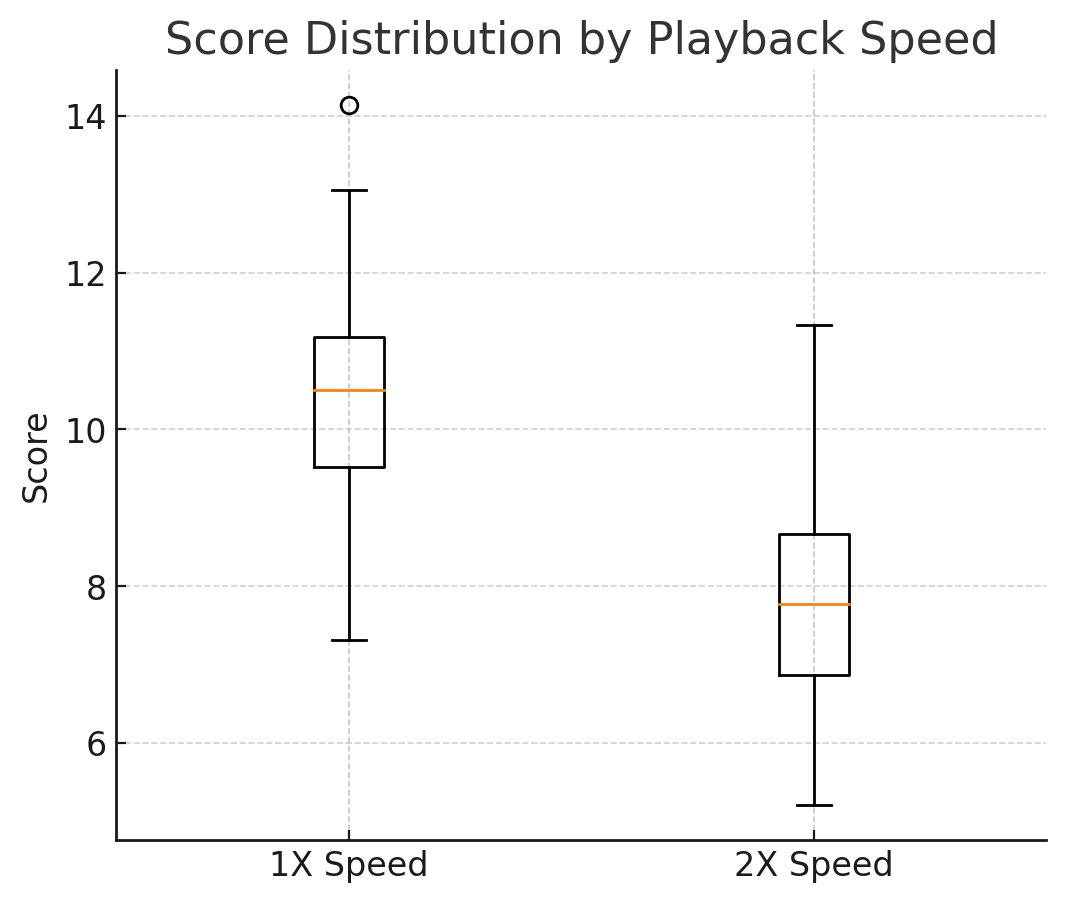
Cognitive performance under time constraints is influenced by multiple factors, including physiological parameters such as hemoglobin (Hb) concentration and red blood cell (RBC) count, which affect oxygen delivery to the brain. However, the extent to which these variables predict performance when task speed is changed remains unclear. This study investigated whether Hb, RBC, age, and sex influence performance when task speed is changed from a normal pace (1X) to a faster pace (2X). An experimental non-randomized controlled trial was conducted among healthy adult participants divided into two study groups: Group A (1X speed) and Group B (2X speed). Hb and RBC levels were measured using standard laboratory procedures and task performance scores were recorded for both groups. Data were analyzed using independent t-tests, Pearson’s correlation and chi-square tests, with significance set at p < 0.05. Higher task speed (2X in Group B) significantly reduced performance scores (p < 0.001). No statistically significant correlations were observed between Hb or RBC levels and performance in either group (p > 0.05). Task speed is a dominant determinant of performance, with faster speeds causing marked decline irrespective of Hb, RBC, age or sex. These findings suggest that within healthy, non-anemic populations, baseline Hb and RBC have limited predictive value for short-term cognitive performance under speeded conditions.
Downloads
References
Sweller J, van Merriënboer JJ, Paas FG. Cognitive architecture and instructional design. Educ Psychol Rev. 1998;10(3):251-296.
Paas F, Renkl A, Sweller J. Cognitive load theory and instructional design: Recent developments. Educ Psychol. 2003;38(1):1-4.
Chandler P, Sweller J. Cognitive load theory and the format of instruction. Cogn Instr. 1991;8(4):293-332.
Ritzhaupt AD, Gomes ND, Barron AE. The effects of time-compressed audio and verbal redundancy on learner performance and satisfaction. Comput Human Behav. 2008;24(5):2434-2445.
Guo PJ, Kim J, Rubin R. How video production affects student engagement: an empirical study of MOOC videos. In: L@S '14: Proceedings of the First ACM Conference on Learning @ Scale. New York: Association for Computing Machinery (ACM); 2014. p.41-50.
van der Meij H, Hopfner C. Eleven guidelines for the design of instructional videos for software training. Tech Commun. 2022;69(3):5-23.
Zhang D, Zhou L, Briggs RO, Nunamaker JF Jr. Instructional video in e-learning: assessing the impact of interactive video on learning effectiveness. Inf Manage. 2006;43(1):15-27.
Boekaerts M. Self-regulated learning: a new concept embraced by researchers, policy makers, educators, teachers, and students. Learn Instr. 1997;7(2):161-186.
Chen CM, Wu CH. Effects of different video lecture types on sustained attention, emotion, cognitive load, and learning performance. Comput Educ. 2015;80:108-121.
van der Meer T. Cognitive adaptation to accelerated video lectures: a study of comprehension and recall. J Appl Res Mem Cogn. 2020;9(2):123-131.
Lee H, Liu M, Scriney M, Smeaton AF. Playback-centric visualizations of video usage using weighted interactions to guide where to watch in an educational context. Front Educ. 2022;7:733646.
Orejuela AR, Espinal EA, Osorio-Andrade CF. Playback speed and learning: effects on objective comprehension and perceived clarity. Front. Educ. 2026;11:1790320.
Murphy DH, Hoover KM, Castel AD. The effect of video playback speed on learning and mind-wandering in younger and older adults. Memory. 2023;31(6):802-817.
Mahi S, Bachhel R, Dhawan R. Association of hemoglobin levels with cognitive performance assessed by digit span test among young adults: A cross-sectional study. AMEI’s Curr Trends Diagn Treat. 2026;10(1):3-6.
Winchester LM, Newby D, Ghose U, Hu P, Green H, Chien S, Ranson JM, Faul J, Llewellyn D, Lee J, Bauermeister S, Nevado-Holgado A. The relationship between anaemia, haemoglobin levels, and cognitive function: Evidence in two population-based cohorts from India and the United States. Neurobiol Dis. 2025;216:107112.
Goel S, Tripathi R. Cognitive sex differences: Evidence from Indian young adults. Journal of Psychosocial Research. 2024;19(1):115-124.
Yu Z. The effects of gender, educational level, and personality on online learning outcomes during the COVID-19 pandemic. Int J Educ Technol High Educ. 2021;18:14.
Lange C, Costley J. Improving online video lectures: learning challenges created by media. Int J Educ Technol High Educ. 2020;17:16.
Lang D, Chen G, Mirzaei K, Paepcke A. Is faster better? In: LAK’20: Proceedings of the Tenth International Conference on Learning Analytics & Knowledge. New York: Association for Computing Machinery (ACM); 2020. p.260-269.
Sweller J. Cognitive load during problem solving: Effects on learning. Cogn Sci. 1988;12(2):257-285.
Paas F, Sweller J. Implications of cognitive load theory for multimedia learning. In: Mayer RE, editor. The Cambridge Handbook of Multimedia Learning. 2nd ed. Cambridge: Cambridge University Press; 2014. p.27-42.
Murphy DH, Hoover KM, Agadzhanyan K, Kuehn JC, Castel AD. Learning in double time: the effect of lecture video speed on immediate and delayed comprehension. Appl Cogn Psychol. 2022;36(1):69-82.
Mo CY, Wang C, Dai J, Jin P. Video playback speed influence on learning effect from the perspective of personalized adaptive learning: A study based on cognitive load theory. Front Psychol. 2022;13:839982.
Fiorella L, Mayer RE. What works and doesn't work with instructional video. Comput Human Behav. 2018;89:465-470.
Zimmerman BJ. Becoming a self-regulated learner: An overview. Theory Pract. 2002;41(2):64-70.
Kizilcec RF, Pérez-Sanagustín M, Maldonado JJ. Self-regulated learning strategies predict learner behavior and goal attainment in massive open online courses. Comput Educ. 2017;104:18-33.
Gaisey IK, Ntroaduro A, Peasah BS, Anane C, Oduro T, Attila FL. Gender differences on the effects of learning environments on academic performance among tertiary students. Education & Youth Research. 2024;4(2):130-139.
Sweller J. Cognitive load theory. In: Mestre JP, Ross BH, editors. Psychology of Learning and Motivation. San Diego: Academic Press; 2011. p.37-76.
Barnett AL, Wenger MJ, Miles P, Wu D, Isingizwe ZR, Benbrook DM, Yuan H. Cognitive performance in relation to systemic and brain iron at perimenopause. Nutrients. 2025;17(5):745.
Jia L, Hao L, Zhang HL. Cognitive performance correlated with hemoglobin level in patients with chronic kidney disease: a data analysis from the National Health and Nutrition Examination Survey (NHANES) 2011- 2014. Kidney Blood Press Res. 2025;50(1):1-26.
Schneider AL, Jonassaint C, Sharrett AR, Mosley TH, Astor BC, Selvin E, Coresh J, Gottesman RF. Hemoglobin, anemia, and cognitive function: The Atherosclerosis Risk in Communities Study. J Gerontol A Biol Sci Med Sci. 2016;71(6):772-779.
Cohen J. A power primer. Psychol Bull. 1992;112(1):155-159.
Núñez F, Maraver MJ, Colzato LS. Sex hormones as cognitive enhancers? J Cogn Enhanc. 2020;4(2):228-233.
Published
License
Copyright (c) 2026 Quench Academy of Medical Education and Research (QAMER)

This work is licensed under a Creative Commons Attribution 4.0 International License.
The authors warrants and represents that the submitted MANUSCRIPT is an original work and has not been published before in any form, and that it does not infringe upon any copyright or other right(s), that it does not contain infringing, libelous, obscene or other unlawful matter, that he/she is the sole and exclusive owner of the rights here-in conveyed to the Publisher, and that he/she has obtained the customary permission from the copyright owner or his legal representative whenever a text/passage from copyrighted material is quoted or a table or illustration from such material is used. The Author(s) will indemnify the Publisher for, and hold the Publisher harmless from any loss, expense or damage occasioned by any claim or suit by a third party for copyright infringement or arising out of any breach of the foregoing warranties as a result of publication of the Article. The Article shall be delivered to the Publisher free of copyright charges. In the event that the Article is not accepted and published by Publisher, this agreement becomes null and void.
Sherpa/Romeo publisher policy can be viewed at Annals of Medical Physiology - Sherpa/Romeo Policy