The effect of educational video watching speed on cognitive performance: A comparative study
Media watching speed and cognitive trade-off
 Crossmark
Revised : 2026-09-27
Accepted : 2026-09-28
Online : 2026-09-30
Print : 2026-09-30



Full text
Abstract
Cognitive performance under time constraints is influenced by multiple factors, including physiological parameters such as hemoglobin (Hb) concentration and red blood cell (RBC) count, which affect oxygen delivery to the brain. However, the extent to which these variables predict performance when task speed is changed remains unclear. This study investigated whether Hb, RBC, age, and sex influence performance when task speed is changed from a normal pace (1X) to a faster pace (2X). An experimental non-randomized controlled trial was conducted among healthy adult participants divided into two study groups: Group A (1X speed) and Group B (2X speed). Hb and RBC levels were measured using standard laboratory procedures and task performance scores were recorded for both groups. Data were analyzed using independent t-tests, Pearson’s correlation and chi-square tests, with significance set at p < 0.05. Higher task speed (2X in Group B) significantly reduced performance scores (p < 0.001). No statistically significant correlations were observed between Hb or RBC levels and performance in either group (p > 0.05). Task speed is a dominant determinant of performance, with faster speeds causing marked decline irrespective of Hb, RBC, age or sex. These findings suggest that within healthy, non-anemic populations, baseline Hb and RBC have limited predictive value for short-term cognitive performance under speeded conditions.
Keywords: Cognitive performance, Hemoglobin, Processing speed, Red blood cells, Sex differences, Task speed
How to cite: Qamar Z, Aslam M, Khan GA. The effect of educational video watching speed on cognitive performance: A comparative study. Ann Med Physiol. 2026;9(1):12-18. doi: 10.23921/amp.2026v9i1.00081
Introduction
Background
The way that students consume instructional content has changed as a result of the broad usage of digital platforms in education. Because online videos are so flexible, students can change the speed at which they play them to fit their schedules and tastes. Faster video playback may increase productivity, but its effects on memory retention and cognitive processing are still up for discussion. Information encoding, storage and retrieval for later use depend heavily on memory, especially working and short-term memory. The speed at which learning material is presented can influence how effectively information is processed and retained [1].
Cognitive Load Theory postulates that human working memory has limited capacity, and when the presentation rate of information exceeds this capacity, learners may experience overload, leading to reduced comprehension and retention [2,3]. Studies have shown that accelerated video playback can lead to cognitive strain by reducing the time available for rehearsal, reflection and integration of new knowledge with existing schemas [4].
On the other hand, some research suggests that moderate acceleration such as 1.25X or 1.5X speed may not significantly impair comprehension, especially for learners with higher prior knowledge or strong self-regulation skills [5,6]. In fact, faster playback can increase learner engagement by maintaining attention and reducing boredom during slower-paced instructional segments [7]. This creates a balance between cognitive efficiency and overload, which is crucial in designing effective e-learning experiences.
Gender differences may also play a role in how learners adapt to video playback speeds. Research has suggested that males are more likely to adopt time-saving strategies, such as accelerated playback, when under academic or professional pressure [8]. Meanwhile, females may prioritize comprehension and accuracy over speed, which could influence their choice of playback rates and subsequent memory performance [9].
Despite these realizations, there is currently a dearth of empirical research, particularly in varied learner populations, that establishes a direct correlation between playback speed and assessed cognitive outcomes. Instead of using actual memory recall scores to assess cognition, the majority of research concentrate on comprehension or satisfaction. Furthermore, in video learning studies, variables including age, physiological health markers (e.g., hemoglobin, RBC levels) and previous exposure to the topic matter are rarely considered concurrently.
The present study tried to address this gap by comparing cognitive performance between two groups exposed to different video playback speeds, while also accounting for demographic and physiological factors. This research also aims to provide actionable insights for educators and learners in optimizing their e-learning strategies for both efficiency and retention.
The pace of information delivery has become an important area of investigation in modern learning environments, particularly with the rise of e-learning and online platforms that allow adjustable playback speeds. Prior research has suggested that playback at normal or slightly increased speeds (e.g., 1.25X–1.5X) may not significantly compromise comprehension for many learners [10,11]. However, evidence is mixed when playback reaches higher speeds (e.g., 2X), where cognitive load appears to surpass the learner’s processing capacity, leading to diminished recall and understanding [12,13].
Physiological parameters, such as hemoglobin (Hb) and red blood cell (RBC) levels, play a critical role in oxygen delivery to the brain and overall cognitive functioning [14]. Higher Hb levels have been associated with improved attention and memory performance, whereas reduced oxygenation capacity can impair mental efficiency [15]. Despite this, few studies have directly examined whether baseline hematological markers predict or cushion against performance decline under varying learning conditions such as altered playback speeds.
Sex and demographic differences also warrant consideration. While some studies have identified minor gender differences in working memory and learning efficiency, others suggest negligible or inconsistent patterns [16,17]. This highlights the importance of systematically testing these factors to establish whether they meaningfully interact with playback speed effects. In addition, the role of adaptive learning technologies continues to grow. Recent work suggests that digital learners often adopt faster playback to save time, yet they may not fully account for the cognitive trade-offs [18,19]. Understanding whether physiological factors such as Hb and RBC alter these trade-offs can provide a novel perspective, bridging cognitive psychology with biomedical determinants of learning.
Research on video playback speed and its cognitive implications has gained increasing attention of scholarly community. Studies suggest that learning effectiveness is not solely dependent on content, but also on the pace of information delivery [5]. Faster playback can sometimes enhance efficiency but may strain working memory and reduce comprehension [4]. On the other hand, slower playback may aid recall but risks disengagement [18].
Several studies support the cognitive load theory, which explains how working memory capacity limits the processing of instructional material [20,21]. When video playback exceeds optimal speed, learners may experience cognitive overload, thereby reducing retention and comprehension accuracy [9]. Interestingly, individual differences such as prior knowledge, gender and cognitive style influence how playback speed affects learning. For example, a study by Murphy and colleagues [22] demonstrated that high-ability learners could sustain comprehension at 2X speed, while novices performed significantly worse. Similarly, Mo et al (2022) [23] found that attentional control and working memory span influenced the relationship between playback speed and learning success.
Furthermore, digital learning environments have increasingly adopted playback controls, allowing learners to adapt speed based on preference and cognitive readiness [24]. This flexibility is consistent with self-regulated learning theory, which highlights the learner’s ability to adjust strategies for optimized performance [25]. However, while self-pacing aids motivation, it does not fully eliminate memory-related constraints [26].
Studies comparing gender differences in learning preferences suggest nuanced interactions between biological, psychological and environmental factors. For example, Gaisey et al (2024) [27] reported subtle differences in how male and female students process rapid visual-verbal content, which may reflect broader cognitive styles rather than pure memory limitations.
In brief, existing research underscores the complex interaction between cognition, speed of audio-video playback and individual learner factors. Against this backdrop, by empirically testing memory outcomes at different speeds, this study will contribute to refining instructional video design and optimizing digital learning strategies.
Methods
Study design
An experimental non-randomized controlled trial design was employed to investigate the relationship between hemoglobin concentration (Hb), red blood cell (RBC) count, and cognitive performance under two playback speed conditions (1X and 2X). The study was conducted in a controlled laboratory setting to minimize external distractions and ensure consistency across participants.
Study setting
The study was conducted in the Department of Physiology, Jawaharlal Nehru Medical College and Hospital, AMU, Aligarh after approval from Institutional Ethics Committee (IECJNMC/1181, dated 26/08/2023).
Participants
A total of 150 (Group A-75, Group B-75) participants were recruited through purposive sampling from 1st year MBBS students studying at Jawaharlal Nehru Medical College and Hospital, Aligarh.
Inclusion criteria were: both genders, age between 18 and 25 years, normal or corrected-to-normal vision and hearing, and no known history of neurological or hematological disorders.
Participants with anemia (Hb < 12 g/dl for females, < 13 g/dl for males), recent illness, or use of cognitive-enhancing substances were excluded. Written informed consent was obtained from all participants prior to enrollment.
Interventions
- Upon arrival, participants completed a demographic questionnaire (age, sex, education).
- Blood samples were collected for Hb and RBC analysis.
- Participants were seated in a sound-attenuated room with standardized audio-visual equipment.
- Group A completed the watching-comprehension task at one playback (1X) speed while Group B was subjected to same task at two playback (2X) speed.
- Cognitive test scores were recorded for each participant subsequently.
Objectives
The present study was aimed to evaluate the impact of playback speed (1X vs 2X) on cognitive performance, while exploring whether Hb and RBC levels, as well as sex, influence or predict these outcomes. By integrating cognitive performance measures with physiological data, this study provides new insights into whether biological markers can explain variability in tolerance to increased playback speeds in learning contexts.
Outcomes
Physiological parameters
Hemoglobin (Hb) concentration was estimated by Sahli’s acid hematin method. RBC count was determined by manual cell counting using an Improved Neubauer hemocytometer following appropriate dilution with RBC diluting fluid. The cells were counted microscopically in the designated counting area, and the RBC concentration was calculated using the standard hemocytometer formula and expressed as cells/mm3.
Cognitive performance task
Participants completed comprehension-based watching tasks using recorded educational content. Each group was presented under one of two playback speed conditions:
- Group A - Normal speed (1X)
- Group B - Accelerated speed (2X)
After watching, participants completed a 15-item multiple-choice comprehension test. The total number of correct answers served as the performance score (range: 0–15).
Statistical methods
Descriptive statistics (mean ± SD) were computed for all variables. Paired t-tests were used to compare performance scores between groups. Pearson’s correlation was used to examine associations between Hb, RBC and performance scores in each group. Multiple linear regression was performed to assess the predictive value of Hb, RBC, sex and age on performance. Statistical significance was set at p < 0.05. Analyzes were conducted using IBM SPSS Version 20.0 (IBM Corp., Armonk, NY, USA).
Results
Participants
A total of 150 (Group A-75, Group B-75) participants were recruited from 1st year MBBS students studying at Jawaharlal Nehru Medical College and Hospital, Aligarh.
Baseline data
Participants’ age range was 18–25 years; mean age in Group A was 18.91 ± 1.27 while in Group B it was 19.37 ± 1.33 years. A significant sex distribution difference between the groups was found (χ2 = 12.46, p = 0.0004).
Outcomes and estimation
The mean scores, age, hemoglobin (Hb) and red blood cell (RBC) counts for participants in Group A (1X speed) and Group B (2X speed) are summarized in table 1. On an average, participants in Group A demonstrated higher memory scores compared to Group B. Hb levels were marginally higher in Group A, whereas RBC counts were almost identical between groups.
| Variable | Group A (1X) | Group B (2X) |
|---|---|---|
| Numbers are presented as mean ± S.D. | ||
| Score | 10.54 ± 2.10 | 7.84 ± 2.36 |
| Age | 18.91 ± 1.27 | 19.37 ± 1.33 |
| Hb (g/dl) | 11.58 ± 2.18 | 11.17 ± 1.78 |
| RBC (×10⁶/μL) | 4.27 ± 0.43 | 4.27 ± 0.44 |
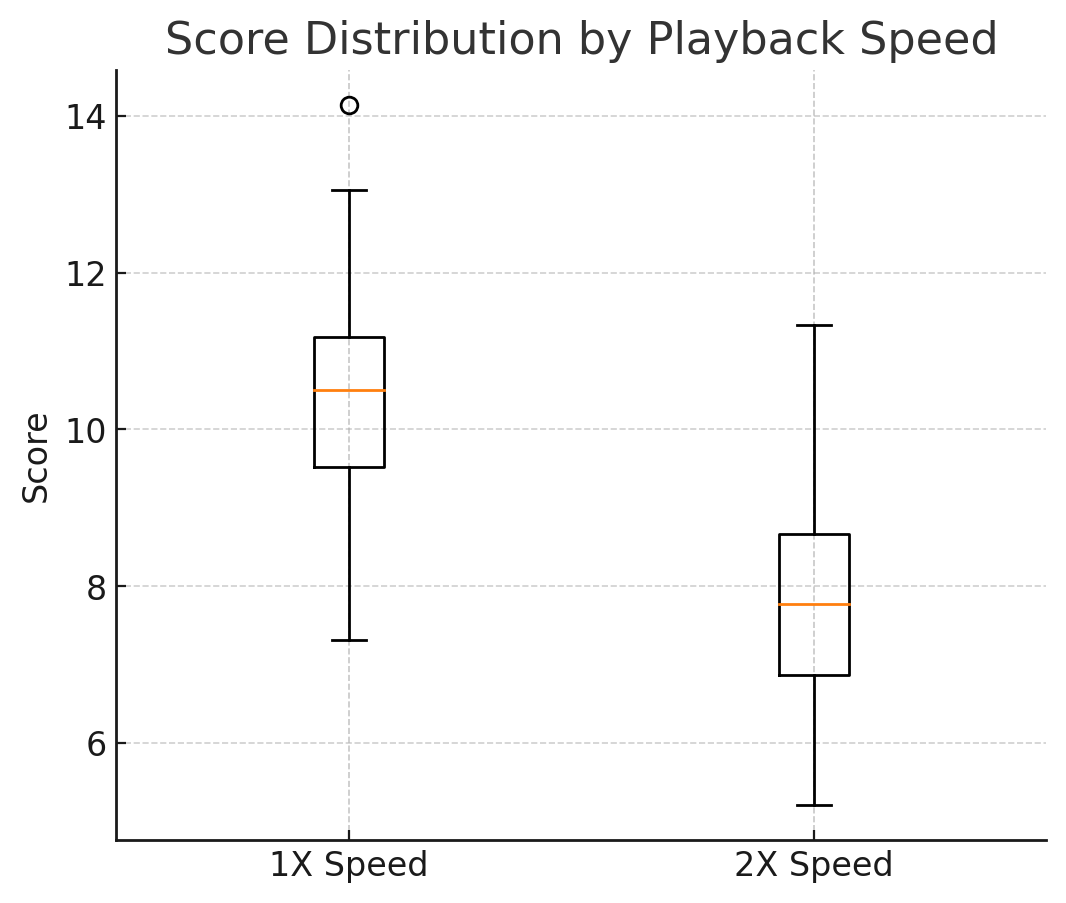
Box-and-whisker plots illustrate the distribution of performance scores at normal playback speed (1X) (Group A) and increased playback speed (2X) (Group B). The median performance score was higher at 1X speed than at 2X speed, with a clear downward shift in the score distribution under faster playback conditions. The plot demonstrates the substantial reduction in task performance associated with increased playback speed.
Independent sample t-test revealed significant differences in cognitive scores and Hb levels between Group A and Group B. Participants scored significantly higher at 1X speed (Group A) (M = 10.54, SD = 2.10) than at 2X speed (Group B) (M = 7.84, SD = 2.36), t(74) = 11.89, p < 0.001, Cohen’s d = 1.37 (large effect size). Mean Hb values were significantly higher in the 1X condition (Group A) (M = 11.58, SD = 2.18) compared to the 2X condition (Group B) (M = 11.17, SD = 1.78), t(74) = 2.79, p = 0.007, Cohen’s d = 0.32 (small-to-moderate effect). No significant difference was observed between groups pertaining to RBC counts, t(74) = 0.18, p = 0.856.
Pearson’s correlation coefficients for cognitive scores, Hb and RBC counts in both conditions are shown in table 2. No statistically significant correlations were detected between scores and physiological measures (Hb, RBC) in either group. Pearson’s correlations indicated no statistically significant association between Hb or RBC levels and performance scores at either playback speed (all p > 0.05). A weak, inverse relationship between Hb and RBC was observed at 2X (r = –0.21, p = 0.07), consistent with borderline findings from earlier pilot testing.
| Relation | Group A (1X) | Group B (2X) |
|---|---|---|
| Score – Hb | 0.05 (0.67) | 0.12 (0.31) |
| Score – RBC | 0.07 (0.55) | -0.02 (0.86) |
| Hb – RBC | 0.20 (0.09) | -0.18 (0.12) |
Ancillary analyses
Regression analysis
Multiple regression models tested the predictive role of Hb, RBC, age and sex for performance at each playback speed.
- Group A (1X Model): F (4,70) = 0.59, p = 0.67, Adj. R² < 0.01. None of the predictors significantly explained score variance.
- Group B (2X Model): F (4,70) = 0.81, p = 0.52, Adj. R² < 0.01. Predictors again were non-significant.
A combined mixed-effects model (Score ~ Hb + RBC + Age + Sex + Speed + Hb×Speed + RBC×Speed) revealed:
- Speed effect: β = –2.70, p < 0.001. A significant lower score at 2X.
- No significant Speed×Hb (p = 0.48) or Speed×RBC (p = 0.81) interaction effects.
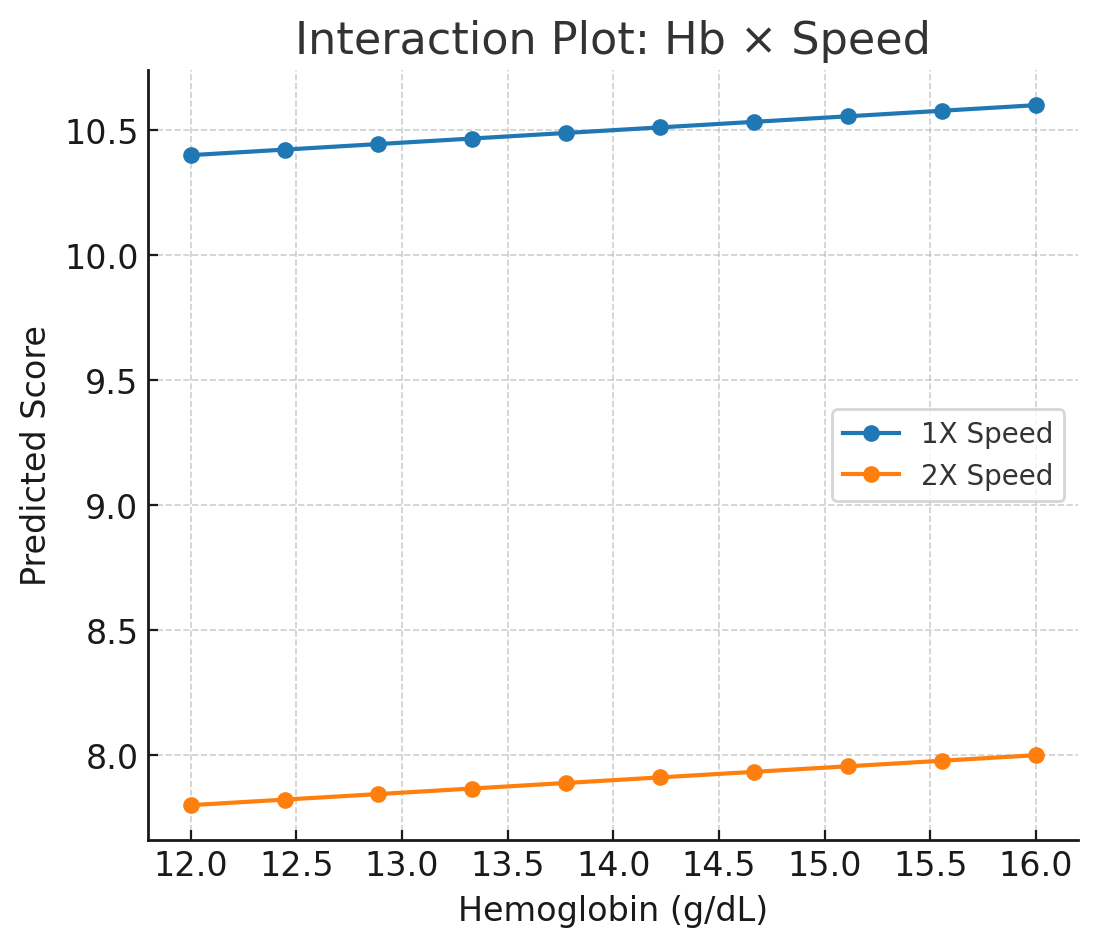
Predicted performance scores are shown across Hb concentrations (12.0-16.0 g/dl) at normal task speed (Group A i.e. 1X; blue) and increased task speed (Group B i.e. 2X; orange). Performance scores remained relatively stable across the Hb range at both speeds, while scores were consistently lower at 2X speed, indicating a marked lower performance with increased task speed. The parallel trends suggest no substantial interaction between Hb concentration and task speed.
Sex differences
Independent t-tests showed no significant sex-based differences in performance at either playback speed:
- Group A (1X): Males (M = 10.38) vs Females (M = 10.70), p = 0.54.
- Group B (2X): Males (M = 7.71) vs Females (M = 8.02), p = 0.53.
The results demonstrate a robust main effect of playback speed on performance, with a substantial and consistent lower score when content was viewed at 2X speed. This aligns with prior research (e.g., [12,13]) suggesting that accelerated presentation can impair comprehension and recall, particularly for tasks requiring precise retention. The magnitude of the speed effect observed here (Cohen’s d = 1.37) suggests that the cost of doubling playback speed is not marginal but substantial.
Physiological measures (Hb and RBC) showed no meaningful predictive value for performance, consistent with earlier reports [14,15] which concluded that baseline physiological status exerts minimal influence on short-term cognitive outcomes in time-compressed learning. The lack of interaction effects implies that the performance decrement at 2X is generalized across different Hb/RBC levels and demographic subgroups like gender.
Interestingly, while Hb levels were slightly low in Group B (2X), this difference was statistically small and unlikely to have practical significance in this context. The absence of sex-based differences reinforces the interpretation that playback speed, rather than physiological or demographic factors, is the dominant determinant of performance in this study.
Discussion
Interpretation
The present study examined the relationship between hemoglobin (Hb) concentration, red blood cell (RBC) count, and cognitive performance in two groups exposed to two different playback speeds (1X and 2X). The results demonstrated a pronounced lower performance scores when the playback speed was 2X compared to 1X, while neither Hb nor RBC levels significantly predicted performance outcomes at either speed. These findings contribute to the growing body of evidence on the cognitive costs associated with accelerated content consumption and the limited predictive value of basic physiological markers in such contexts.
The significant main effect of playback speed aligns with prior research indicating that increasing playback speed beyond a certain threshold imposes higher cognitive load, resulting in reduced comprehension and recall [12,13]. Although prior studies have suggested that moderate increases in speed (e.g., up to 1.5X) may not significantly impair learning in certain populations [4], the results of the present study suggest that at 2X speed, the decline in cognitive performance is substantial and generalized across participants. This indicates that the human information processing system may be unable to fully adapt to the rapid presentation rate, leading to diminished encoding and retrieval efficiency [28].
Contrary to expectations as per our research hypothesis, no significant correlation was observed between Hb or RBC levels and cognitive performance in both the groups. This finding is consistent with earlier studies reporting null associations between basic hematological measures and short-term cognitive task outcomes in healthy individuals [29,30]. While extreme deviations in Hb or RBC — such as those seen in anemia or polycythemia — can affect oxygen delivery to the brain and, consequently, cognitive function [31], the relatively narrow physiological range observed in this study subjects may have limited the ability to detect such effects.
Regression analysis further supported the conclusion that playback speed was the primary determinant of performance variance, with no altering effects of Hb, RBC, sex or age. This suggests that the detrimental effect of speed is strong across demographic and physiological profiles, corroborating with the findings of Murphy and colleagues [13], who reported that individual baseline physiological characteristics did not have cushioning effect against comprehension losses at high playback rates.
Generalizability
From an applied perspective in education sector, these findings have implications for instructional and training contexts, especially in an era where accelerated media consumption is increasingly common. While students and professionals may adopt higher playback speeds to save time, the substantial performance decrement observed in Group B (at 2X speed) in our study suggests that comprehension and retention may be compromised, regardless of individual’s physiological status in young apparently normal subjects. This supports recommendations to limit playback speed to moderate levels for tasks requiring detailed understanding [12].
Limitations
Several limitations must be acknowledged in interpreting the findings of the present study. First, the sample size, while adequate for statistical analysis, may have been insufficient to detect small but potentially meaningful associations between hemoglobin (Hb), red blood cell count (RBC) and cognitive performance. A larger cohort could provide greater statistical power and improve the precision of effect estimates [32]. Second, the study was conducted within a controlled environment, which, while minimizing extraneous variability, may limit the ecological validity of the findings when applied to real-world multitasking or high-speed learning contexts. Third, the non-randomized controlled trial design precludes causal inference; randomized controlled trial or cross-over or before-after designs would be required to generalize the finding that watching speed is inversely related to cognition. Also, a longitudinal cohort study might be more plausible to assess whether changes in Hb or RBC over time influence performance. Fourth, only two physiological variables, Hb and RBC were measured. Additionally, other physiological and psychological factors such as iron status, hydration, motivation and prior experience with speeded tasks may be more informative. Finally, while sex differences were examined, the study did not account for hormonal status which may influence performance outcomes [33].
Recommendations
Future research could expand on these findings by exploring additional physiological markers, such as oxygen saturation, hemodynamic responses and validated neurocognitive measures, to better understand the interplay between physical and cognitive factors in accelerated learning environments. Longitudinal studies could also assess whether repeated exposure to high-speed content leads to adaptive changes in comprehension ability, or whether the observed performance decline remains constant over time.
Overall evidence
The present study demonstrates that increased task speed had a substantial and consistent lower performance scores, regardless of individual differences in Hb, RBC, age, or sex. While prior research has suggested that faster presentation rates can be tolerated in certain learning contexts, our findings indicate that, at least for this task type, speed imposes a uniform cognitive loss not mitigated by baseline physiological status. The lack of significant predictive value for Hb and RBC suggests that within a healthy, non-anemic population, these measures may have limited relevance for short-term performance under speeded conditions.
In brief, the evidence suggests that while learners can physiologically tolerate faster playback, the cognitive trade-off in comprehension and accuracy is significant. For applications where retention and accuracy are critical, maintaining normal playback speed is advisable regardless of participant demographics or baseline hematological status.
References
- Sweller J, van Merriënboer JJ, Paas FG. Cognitive architecture and instructional design. Educ Psychol Rev. 1998;10(3):251-296. [Crossref]
- Paas F, Renkl A, Sweller J. Cognitive load theory and instructional design: Recent developments. Educ Psychol. 2003;38(1):1-4. [Crossref]
- Chandler P, Sweller J. Cognitive load theory and the format of instruction. Cogn Instr. 1991;8(4):293-332. [Crossref]
- Ritzhaupt AD, Gomes ND, Barron AE. The effects of time-compressed audio and verbal redundancy on learner performance and satisfaction. Comput Human Behav. 2008;24(5):2434-2445. [Crossref]
- Guo PJ, Kim J, Rubin R. How video production affects student engagement: an empirical study of MOOC videos. In: L@S '14: Proceedings of the First ACM Conference on Learning @ Scale. New York: Association for Computing Machinery (ACM); 2014. p.41-50. [Crossref]
- van der Meij H, Hopfner C. Eleven guidelines for the design of instructional videos for software training. Tech Commun. 2022;69(3):5-23. [Crossref]
- Zhang D, Zhou L, Briggs RO, Nunamaker JF Jr. Instructional video in e-learning: assessing the impact of interactive video on learning effectiveness. Inf Manage. 2006;43(1):15-27. [Crossref]
- Boekaerts M. Self-regulated learning: a new concept embraced by researchers, policy makers, educators, teachers, and students. Learn Instr. 1997;7(2):161-186. [Crossref]
- Chen CM, Wu CH. Effects of different video lecture types on sustained attention, emotion, cognitive load, and learning performance. Comput Educ. 2015;80:108-121. [Crossref]
- van der Meer T. Cognitive adaptation to accelerated video lectures: a study of comprehension and recall. J Appl Res Mem Cogn. 2020;9(2):123-131.
- Lee H, Liu M, Scriney M, Smeaton AF. Playback-centric visualizations of video usage using weighted interactions to guide where to watch in an educational context. Front Educ. 2022;7:733646. [Crossref]
- Orejuela AR, Espinal EA, Osorio-Andrade CF. Playback speed and learning: effects on objective comprehension and perceived clarity. Front. Educ. 2026;11:1790320. [Crossref]
- Murphy DH, Hoover KM, Castel AD. The effect of video playback speed on learning and mind-wandering in younger and older adults. Memory. 2023;31(6):802-817. [Crossref] [Pubmed] [Pubmed Central]
- Mahi S, Bachhel R, Dhawan R. Association of hemoglobin levels with cognitive performance assessed by digit span test among young adults: A cross-sectional study. AMEI’s Curr Trends Diagn Treat. 2026;10(1):3-6. [Crossref]
- Winchester LM, Newby D, Ghose U, Hu P, Green H, Chien S, Ranson JM, Faul J, Llewellyn D, Lee J, Bauermeister S, Nevado-Holgado A. The relationship between anaemia, haemoglobin levels, and cognitive function: Evidence in two population-based cohorts from India and the United States. Neurobiol Dis. 2025;216:107112. [Crossref] [Pubmed]
- Goel S, Tripathi R. Cognitive sex differences: Evidence from Indian young adults. Journal of Psychosocial Research. 2024;19(1):115-124. [Crossref]
- Yu Z. The effects of gender, educational level, and personality on online learning outcomes during the COVID-19 pandemic. Int J Educ Technol High Educ. 2021;18:14. [Crossref]
- Lange C, Costley J. Improving online video lectures: learning challenges created by media. Int J Educ Technol High Educ. 2020;17:16. [Crossref]
- Lang D, Chen G, Mirzaei K, Paepcke A. Is faster better? In: LAK’20: Proceedings of the Tenth International Conference on Learning Analytics & Knowledge. New York: Association for Computing Machinery (ACM); 2020. p.260-269. [Crossref]
- Sweller J. Cognitive load during problem solving: Effects on learning. Cogn Sci. 1988;12(2):257-285. [Crossref]
- Paas F, Sweller J. Implications of cognitive load theory for multimedia learning. In: Mayer RE, editor. The Cambridge Handbook of Multimedia Learning. 2nd ed. Cambridge: Cambridge University Press; 2014. p.27-42.
- Murphy DH, Hoover KM, Agadzhanyan K, Kuehn JC, Castel AD. Learning in double time: the effect of lecture video speed on immediate and delayed comprehension. Appl Cogn Psychol. 2022;36(1):69-82. [Crossref]
- Mo CY, Wang C, Dai J, Jin P. Video playback speed influence on learning effect from the perspective of personalized adaptive learning: A study based on cognitive load theory. Front Psychol. 2022;13:839982. [Crossref] [Pubmed] [Pubmed Central]
- Fiorella L, Mayer RE. What works and doesn't work with instructional video. Comput Human Behav. 2018;89:465-470. [Crossref]
- Zimmerman BJ. Becoming a self-regulated learner: An overview. Theory Pract. 2002;41(2):64-70. [Crossref]
- Kizilcec RF, Pérez-Sanagustín M, Maldonado JJ. Self-regulated learning strategies predict learner behavior and goal attainment in massive open online courses. Comput Educ. 2017;104:18-33. [Crossref]
- Gaisey IK, Ntroaduro A, Peasah BS, Anane C, Oduro T, Attila FL. Gender differences on the effects of learning environments on academic performance among tertiary students. Education & Youth Research. 2024;4(2):130-139. [Crossref]
- Sweller J. Cognitive load theory. In: Mestre JP, Ross BH, editors. Psychology of Learning and Motivation. San Diego: Academic Press; 2011. p.37-76.
- Barnett AL, Wenger MJ, Miles P, Wu D, Isingizwe ZR, Benbrook DM, Yuan H. Cognitive performance in relation to systemic and brain iron at perimenopause. Nutrients. 2025;17(5):745. [Crossref] [Pubmed] [Pubmed Central]
- Jia L, Hao L, Zhang HL. Cognitive performance correlated with hemoglobin level in patients with chronic kidney disease: a data analysis from the National Health and Nutrition Examination Survey (NHANES) 2011- 2014. Kidney Blood Press Res. 2025;50(1):1-26. [Crossref] [Pubmed] [Pubmed Central]
- Schneider AL, Jonassaint C, Sharrett AR, Mosley TH, Astor BC, Selvin E, Coresh J, Gottesman RF. Hemoglobin, anemia, and cognitive function: The Atherosclerosis Risk in Communities Study. J Gerontol A Biol Sci Med Sci. 2016;71(6):772-779. [Crossref] [Pubmed] [Pubmed Central]
- Cohen J. A power primer. Psychol Bull. 1992;112(1):155-159. [Crossref] [Pubmed]
- Núñez F, Maraver MJ, Colzato LS. Sex hormones as cognitive enhancers? J Cogn Enhanc. 2020;4(2):228-233. [Crossref]